Model Gallery

38 models from 1 repositories

Filter by type:

Filter by tags:

qwen3.8-27b-q4
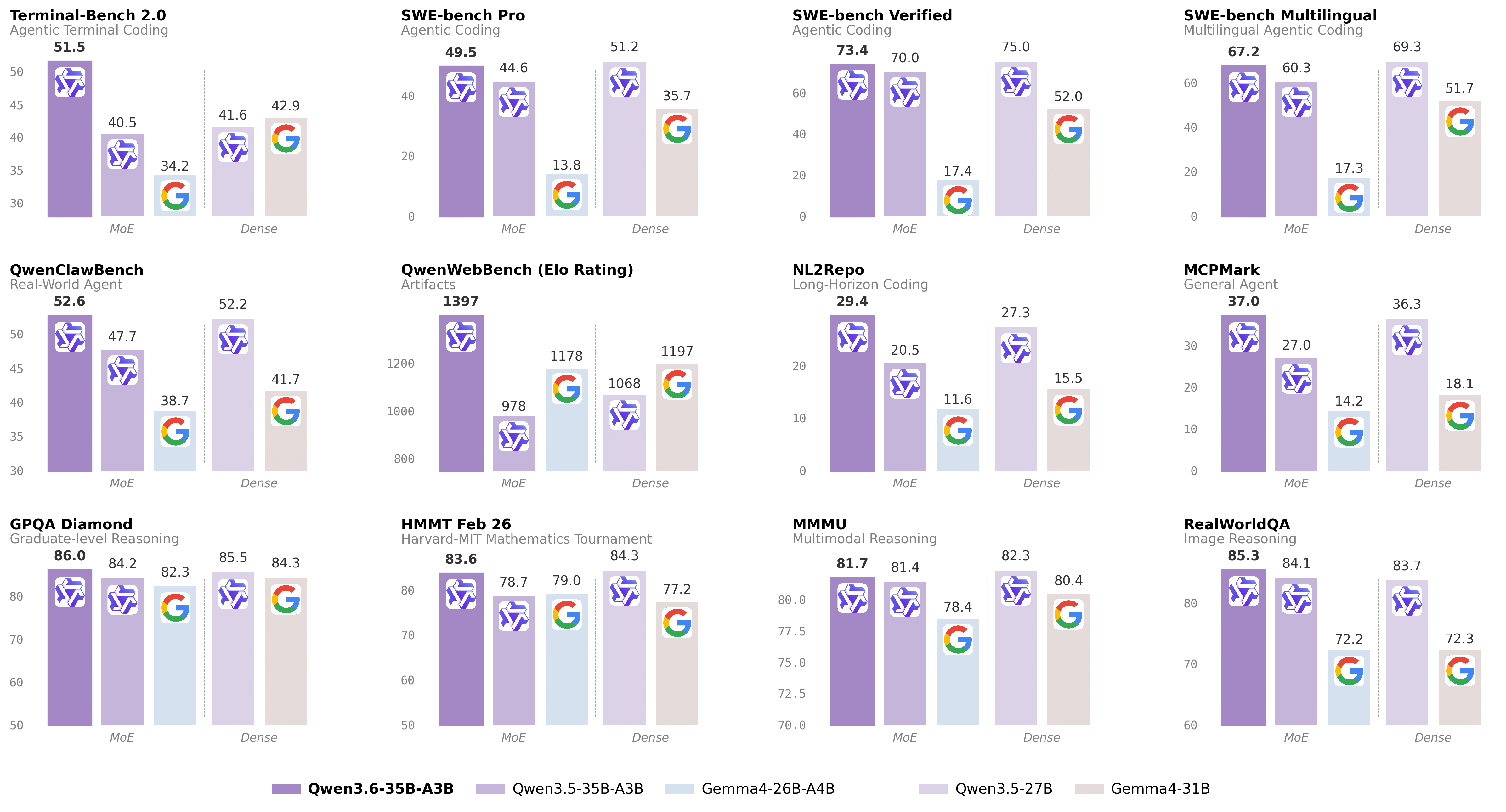
Qwen3.8-27B is Qwen's dense 27B vision-language model for reasoning, coding, tool use, and long-running agent tasks. It accepts text, images, and video, and it supports a native context window of 262K tokens. This default entry uses the official Q4_K_M GGUF and Q8_0 vision projector. The linked variants add MTP speculative decoding or use the higher-quality Q8_0 model.

Repository: localaiLicense: apache-2.0

qwen3.5-9b-hauhaucs-aggressive
Qwen3.5 9B Aggressive is HauhauCS's refusal-removed fine-tune of the multimodal Qwen3.5 9B model. It retains the base model's reasoning, tool use, image and video understanding, and 262K-token native context window. This entry uses the balanced Q4_K_M GGUF quantization and includes the matching BF16 multimodal projector. The Q8_0 variant offers higher fidelity.

Repository: localaiLicense: apache-2.0

qwen3.5-9b-hauhaucs-aggressive-q8
Qwen3.5 9B Aggressive is HauhauCS's refusal-removed fine-tune of the multimodal Qwen3.5 9B model. It retains the base model's reasoning, tool use, image and video understanding, and 262K-token native context window. This entry uses the higher-fidelity Q8_0 GGUF quantization and includes the matching BF16 multimodal projector.

Repository: localaiLicense: apache-2.0

gemma-4-12b-agentic-fable5-composer2.5-v2-3.5x-tau2
Hugging Face | GitHub | Launch Blog | Documentation License: Apache 2.0 | Authors: Google DeepMind > [!Note] > This model card is for the Gemma 4 12B Unified model, which is part of the Gemma 4 family of open models. Built with the same multimodal functionality as Gemma 4 E2B and E4B (text, audio, image, and video inputs), it brings native audio and vision understanding directly to local environments without the need for separate encoders. This unified approach to multimodality makes the model encoder-free, offering a deployment size that is perfect for consumer devices and streamlined local execution. Gemma is a family of open models built by Google DeepMind. Gemma 4 models are multimodal, handling text and image input (with audio supported on E2B, E4B, and 12B) and generating text output. This release includes open-weights models in both pre-trained and instruction-tuned variants. Gemma 4 features a context window of up to 256K tokens and maintains multilingual support in over 140 languages. ...

Repository: localaiLicense: apache-2.0

gemma-4-12b-coder-fable5-composer2.5-v1
Hugging Face | GitHub | Launch Blog | Documentation License: Apache 2.0 | Authors: Google DeepMind > [!Note] > This model card is for the Gemma 4 12B Unified model, which is part of the Gemma 4 family of open models. Built with the same multimodal functionality as Gemma 4 E2B and E4B (text, audio, image, and video inputs), it brings native audio and vision understanding directly to local environments without the need for separate encoders. This unified approach to multimodality makes the model encoder-free, offering a deployment size that is perfect for consumer devices and streamlined local execution. Gemma is a family of open models built by Google DeepMind. Gemma 4 models are multimodal, handling text and image input (with audio supported on E2B, E4B, and 12B) and generating text output. This release includes open-weights models in both pre-trained and instruction-tuned variants. Gemma 4 features a context window of up to 256K tokens and maintains multilingual support in over 140 languages. ...

Repository: localaiLicense: gemma

nemotron-3-nano-omni-30b-a3b-reasoning-apex
# Model Overview ### Description: NVIDIA Nemotron 3 Nano Omni is a multimodal large language model that unifies video, audio, image, and text understanding to support enterprise-grade Q&A, summarization, transcription, and document intelligence workflows. It extends the Nemotron Nano family with integrated video+speech comprehension, Graphical User Interface (GUI), Optical Character Recognition (OCR), and speech transcription capabilities, enabling end-to-end processing of rich enterprise content such as meeting recordings, M&E assets, training videos, and complex business documents. NVIDIA Nemotron 3 Nano Omni was developed by NVIDIA as part of the Nemotron model family. This model is available for commercial use. This model was improved using Qwen3-VL-30B-A3B-Instruct, Qwen3.5-122B-A10B, Qwen3.5-397B-A17B, Qwen2.5-VL-72B-Instruct, and gpt-oss-120b. For more information, please see the Training Dataset section below. ### License/Terms of Use Governing Terms: Use of this model is governed by the NVIDIA Open Model Agreement ### Deployment Geography: Global ...

Repository: localaiLicense: other

qwen3.6-35b-a3b-claude-4.6-opus-reasoning-distilled
# 🔥 Qwen3.6-35B-A3B-Claude-4.6-Opus-Reasoning-Distilled A reasoning SFT fine-tune of `Qwen/Qwen3.6-35B-A3B` on chain-of-thought (CoT) distillation mostly sourced from Claude Opus 4.6. The goal is to preserve Qwen3.6's strong agentic coding and reasoning base while nudging the model toward structured Claude Opus-style reasoning traces and more stable long-form problem solving. The training path is text-only. The Qwen3.6 base architecture includes a vision encoder, but this fine-tuning run did not train on image or video examples. - **Developed by:** @hesamation - **Base model:** `Qwen/Qwen3.6-35B-A3B` - **License:** apache-2.0 This fine-tuning run is inspired by Jackrong/Qwen3.5-27B-Claude-4.6-Opus-Reasoning-Distilled, including the notebook/training workflow style and Claude Opus reasoning-distillation direction. [](https://x.com/Hesamation) [](https://discord.gg/vtJykN3t) ## Benchmark Results The MMLU-Pro pass used 70 total questions per model: `--limit 5` across 14 MMLU-Pro subjects. Treat this as a smoke/comparative check, not a release-quality full benchmark. ...

Repository: localaiLicense: apache-2.0

vllm-omni-wan2.2-t2v
Wan2.2-T2V-A14B via vLLM-Omni - Text-to-video generation model from Wan-AI. Generates high-quality videos from text prompts using a 14B parameter diffusion model.

Repository: localaiLicense: apache-2.0

vllm-omni-wan2.2-i2v
Wan2.2-I2V-A14B via vLLM-Omni - Image-to-video generation model from Wan-AI. Generates high-quality videos from images using a 14B parameter diffusion model.

Repository: localaiLicense: apache-2.0

longcat-video
LongCat-Video served by LocalAI's dedicated CUDA backend. Generates video from a text prompt or a start image. The SDPA attention path works without FlashAttention and is suitable for CUDA 13 ARM64 systems such as DGX Spark. This is a very large checkpoint (roughly 83 GB in Hugging Face storage) and requires Linux with an NVIDIA CUDA GPU plus substantial memory and disk.

Repository: localaiLicense: mit

longcat-video-avatar-1.5
LongCat-Video-Avatar-1.5 served by LocalAI's dedicated CUDA backend. Turns speech plus a prompt into an avatar video, optionally conditioning on a portrait, and continues across multiple segments for longer audio. Avatar generation also loads tokenizer, text encoder, and VAE components from LongCat-Video. Plan for very large downloads and substantial NVIDIA GPU or unified memory; CPU and macOS execution are unsupported.

Repository: localaiLicense: mit

minimax-h3-fl2va-q4
MiniMax-H3 served by vllm.cpp, LocalAI's own C++ port of vLLM. It generates video AND audio jointly from a text prompt, so a clip comes back as an MP4 with a real soundtrack rather than a silent render: ask for speech in the prompt and the model lip-syncs it. This is the Q4_K_M quantisation of the FL2VA partition, which serves text-to-video (t2va) and first/last-frame conditioning (fl2va). Reference conditioning (ref2va) is a different checkpoint and is refused by this one. Roughly 40 GB of weights across five files, plus the two VAE configs that carry the latent statistics. The default canvas is 1344x768 at 124 frames and 24 fps, about 5.2 seconds. Generation is slow — measured at roughly 176 s per denoise step at that canvas on a 20-SM device, so the 50-step default is a multi-hour job. Muxing the finished frames needs ffmpeg on the host.

Repository: localaiLicense: other

minimax-h3-ref2va-q4
MiniMax-H3 served by vllm.cpp, LocalAI's own C++ port of vLLM. It generates video AND audio jointly, so a clip comes back as an MP4 with a real soundtrack rather than a silent render. This is the Q4_K_M quantisation of the Ref2VA partition, the one that takes REFERENCE conditioning: a reference image, a reference clip, or reference audio, prepended as their own blocks so the subject or style carries into the generated video. For plain text-to-video or first/last-frame conditioning use minimax-h3-fl2va-q4 instead - the two partitions are separate checkpoints and each refuses the other's tasks. Use this Q4_K_M build, NOT the NVFP4 Ref2VA weights: NVFP4 renders a multicolour patch grid, and it took three investigations upstream to establish that the fault is the quantisation rather than the reference path. On Q4_K_M the same code renders coherently. Roughly 40 GB of weights across five files, plus the two VAE configs that carry the latent statistics. The default canvas is 1344x768 at 124 frames and 24 fps, about 5.2 seconds. Generation is slow - roughly 176 s per denoise step at that canvas on a 20-SM device, so the 50-step default is a multi-hour job. Muxing the finished frames needs ffmpeg on the host.

Repository: localaiLicense: other

vllm-omni-qwen3-omni-30b
Qwen3-Omni-30B-A3B-Instruct via vLLM-Omni - A large multimodal model (30B active, 3B activated per token) from Alibaba Qwen team. Supports text, image, audio, and video understanding with text and speech output. Features native multimodal understanding across all modalities.

Repository: localaiLicense: apache-2.0

qwen3-vl-embedding-8b
**Model Name:** Qwen3-VL-Embedding-8B **Base Model:** Qwen/Qwen3-VL-8B-Instruct **Description:** The **Qwen3-VL-Embedding** and **Qwen3-VL-Reranker** model series are the latest additions to the Qwen family, built upon the recently open-sourced and powerful Qwen3-VL foundation model. Specifically designed for multimodal information retrieval and cross-modal understanding, this suite accepts diverse inputs including text, images, screenshots, and videos, as well as inputs containing a mixture of these modalities. **Key Features:** - Model Type: MultiModal Embedding - Supported Languages: 30+ Languages - Supported Input Modalities: Text, images, screenshots, videos, and arbitrary multimodal combinations (e.g., text + image, text + video) - Number of Parameters: 8B - Context Length: 32k - Embedding Dimension: Up to 4096, supports user-defined output dimensions ranging from 64 to 4096 **Downloads:** - [GGUF Files](https://huggingface.co/Qwen/Qwen3-VL-Embedding-8B) (e.g., `Qwen3-VL-Embedding-8B-Q8_0.gguf`). **Usage:** - Requires `transformers`, `qwen-vl-utils`, and `torch`. - Example: `from scripts.qwen3_vl_embedding import Qwen3VLEmbedder model = Qwen3VLEmbedder(...)` **Citation:** @article{qwen3vlembedding, ...} This description emphasizes its capabilities, efficiency, and versatility for multimodal search tasks.

Repository: localaiLicense: apache-2.0

qwen3-vl-embedding-2b
**Model Name:** Qwen3-VL-Embedding-2B **Base Model:** Qwen/Qwen3-VL-2B-Instruct **Description:** The **Qwen3-VL-Embedding** and **Qwen3-VL-Reranker** model series are the latest additions to the Qwen family, built upon the recently open-sourced and powerful Qwen3-VL foundation model. Specifically designed for multimodal information retrieval and cross-modal understanding, this suite accepts diverse inputs including text, images, screenshots, and videos, as well as inputs containing a mixture of these modalities. **Key Features:** - Model Type: MultiModal Embedding - Supported Languages: 30+ Languages - Supported Input Modalities: Text, images, screenshots, videos, and arbitrary multimodal combinations (e.g., text + image, text + video) - Number of Parameters: 2B - Context Length: 32k - Embedding Dimension: Up to 2048, supports user-defined output dimensions ranging from 64 to 2048 **Downloads:** - [GGUF Files](https://huggingface.co/Qwen/Qwen3-VL-Embedding-2B) (e.g., `Qwen3-VL-Embedding-2B-Q8_0.gguf`). **Usage:** - Requires `transformers`, `qwen-vl-utils`, and `torch`. - Example: `from scripts.qwen3_vl_embedding import Qwen3VLEmbedder model = Qwen3VLEmbedder(...)` **Citation:** @article{qwen3vlembedding, ...} This description emphasizes its capabilities, efficiency, and versatility for multimodal search tasks.

Repository: localaiLicense: apache-2.0

qwen3-vl-reranker-8b
**Model Name:** Qwen3-VL-Reranker-8B **Base Model:** Qwen/Qwen3-VL-Reranker-8B **Description:** A high-performance multimodal reranking model for state-of-the-art cross-modal search. It supports 30+ languages and handles text, images, screenshots, videos, and mixed modalities. With 8B parameters and a 32K context length, it refines retrieval results by combining embedding vectors with precise relevance scores. Optimized for efficiency, it supports quantized versions (e.g., Q8_0, Q4_K_M) and is ideal for applications requiring accurate multimodal content matching. **Key Features:** - **Multimodal**: Text, images, videos, and mixed content. - **Language Support**: 30+ languages. - **Quantization**: Available in Q8_0 (best quality), Q4_K_M (fast, recommended), and lower-precision options. - **Performance**: Outperforms base models in retrieval tasks (e.g., JinaVDR, ViDoRe v3). - **Use Case**: Enhances search pipelines by refining embeddings with precise relevance scores. **Downloads:** - [GGUF Files](https://huggingface.co/mradermacher/Qwen3-VL-Reranker-8B-GGUF) (e.g., `Qwen3-VL-Reranker-8B.Q8_0.gguf`). **Usage:** - Requires `transformers`, `qwen-vl-utils`, and `torch`. - Example: `from scripts.qwen3_vl_reranker import Qwen3VLReranker; model = Qwen3VLReranker(...)` **Citation:** @article{qwen3vlembedding, ...} This description emphasizes its capabilities, efficiency, and versatility for multimodal search tasks.

Repository: localaiLicense: apache-2.0

qwen3-vl-reranker-2b-i1
**Model Name:** Qwen3-VL-Reranker-2B-i1 **Base Model:** Qwen/Qwen3-VL-Reranker-2B **Description:** A high-performance multimodal reranking model for state-of-the-art cross-modal search. It supports 30+ languages and handles text, images, screenshots, videos, and mixed modalities. With 8B parameters and a 32K context length, it refines retrieval results by combining embedding vectors with precise relevance scores. Optimized for efficiency, it supports quantized versions (e.g., Q8_0, Q4_K_M) and is ideal for applications requiring accurate multimodal content matching. **Key Features:** - **Multimodal**: Text, images, videos, and mixed content. - **Language Support**: 30+ languages. - **Quantization**: Available in Q8_0 (best quality), Q4_K_M (fast, recommended), and lower-precision options. - **Performance**: Outperforms base models in retrieval tasks (e.g., JinaVDR, ViDoRe v3). - **Use Case**: Enhances search pipelines by refining embeddings with precise relevance scores. **Downloads:** - [GGUF Files](https://huggingface.co/mradermacher/Qwen3-VL-Reranker-2B-i1-GGUF) (e.g., `Qwen3-VL-Reranker-2B.i1-Q4_K_M.gguf`). **Usage:** - Requires `transformers`, `qwen-vl-utils`, and `torch`. - Example: `from scripts.qwen3_vl_reranker import Qwen3VLReranker; model = Qwen3VLReranker(...)` **Citation:** @article{qwen3vlembedding, ...} This description emphasizes its capabilities, efficiency, and versatility for multimodal search tasks.

Repository: localaiLicense: apache-2.0

qwen3-vl-30b-a3b-instruct
Meet Qwen3-VL — the most powerful vision-language model in the Qwen series to date. This generation delivers comprehensive upgrades across the board: superior text understanding & generation, deeper visual perception & reasoning, extended context length, enhanced spatial and video dynamics comprehension, and stronger agent interaction capabilities. Available in Dense and MoE architectures that scale from edge to cloud, with Instruct and reasoning‑enhanced Thinking editions for flexible, on-demand deployment. #### Key Enhancements: * **Visual Agent**: Operates PC/mobile GUIs—recognizes elements, understands functions, invokes tools, completes tasks. * **Visual Coding Boost**: Generates Draw.io/HTML/CSS/JS from images/videos. * **Advanced Spatial Perception**: Judges object positions, viewpoints, and occlusions; provides stronger 2D grounding and enables 3D grounding for spatial reasoning and embodied AI. * **Long Context & Video Understanding**: Native 256K context, expandable to 1M; handles books and hours-long video with full recall and second-level indexing. * **Enhanced Multimodal Reasoning**: Excels in STEM/Math—causal analysis and logical, evidence-based answers. * **Upgraded Visual Recognition**: Broader, higher-quality pretraining is able to “recognize everything”—celebrities, anime, products, landmarks, flora/fauna, etc. * **Expanded OCR**: Supports 32 languages (up from 19); robust in low light, blur, and tilt; better with rare/ancient characters and jargon; improved long-document structure parsing. * **Text Understanding on par with pure LLMs**: Seamless text–vision fusion for lossless, unified comprehension. #### Model Architecture Updates: 1. **Interleaved-MRoPE**: Full‑frequency allocation over time, width, and height via robust positional embeddings, enhancing long‑horizon video reasoning. 2. **DeepStack**: Fuses multi‑level ViT features to capture fine-grained details and sharpen image–text alignment. 3. **Text–Timestamp Alignment:** Moves beyond T‑RoPE to precise, timestamp‑grounded event localization for stronger video temporal modeling. This is the weight repository for Qwen3-VL-30B-A3B-Instruct.

Repository: localaiLicense: apache-2.0

qwen3-omni-30b-a3b-instruct
Qwen3-Omni is the natively end-to-end multilingual omni-modal foundation model. It processes text, images, audio, and video, and delivers real-time streaming responses in both text and natural speech. This GGUF build runs on llama.cpp with the bundled mmproj for multimodal inputs.

Repository: localaiLicense: apache-2.0

ltx-2
**LTX-2** is a DiT-based audio-video foundation model designed to generate synchronized video and audio within a single model. It brings together the core building blocks of modern video generation, with open weights and a focus on practical, local execution. **Key Features:** - **Joint Audio-Video Generation**: Generates synchronized video and audio in a single model - **Image-to-Video**: Converts static images into dynamic videos with matching audio - **High Quality**: Produces realistic video with natural motion and synchronized audio - **Open Weights**: Available under the LTX-2 Community License Agreement **Model Details:** - **Model Type**: Diffusion-based audio-video foundation model - **Architecture**: DiT (Diffusion Transformer) based - **Developed by**: Lightricks - **Paper**: [LTX-2: Efficient Joint Audio-Visual Foundation Model](https://arxiv.org/abs/2601.03233) **Usage Tips:** - Width & height settings must be divisible by 32 - Frame count must be divisible by 8 + 1 (e.g., 9, 17, 25, 33, 41, 49, 57, 65, 73, 81, 89, 97, 105, 113, 121) - Recommended settings: width=768, height=512, num_frames=121, frame_rate=24.0 - For best results, use detailed prompts describing motion and scene dynamics **Limitations:** - This model is not intended or able to provide factual information - Prompt following is heavily influenced by the prompting-style - When generating audio without speech, the audio may be of lower quality **Citation:** ```bibtex @article{hacohen2025ltx2, title={LTX-2: Efficient Joint Audio-Visual Foundation Model}, author={HaCohen, Yoav and Brazowski, Benny and Chiprut, Nisan and others}, journal={arXiv preprint arXiv:2601.03233}, year={2025} } ```

Repository: localaiLicense: ltx-2-community-license-agreement

Page 1