Model Gallery

239 models from 1 repositories

Filter by type:

Filter by tags:

qwen3.8-27b-ridge
Qwen3.8-27B Ridge is a 3.69-bit mixed quantization that keeps the Gated-DeltaNet state path at Q8_0 and preserves the embedded MTP head. It reduces the model weights to 12.59 GB while retaining multimodal, reasoning, coding, tool-use, and long-context capabilities.

Repository: localaiLicense: apache-2.0

nemotron-3.5-lightning-30b-a3b-nvfp4
NVIDIA Nemotron 3.5 Lightning 30B-A3B in the official NVFP4 GGUF format. This is the smallest linked build and retains the model's reasoning, coding, tool-use, multilingual, and long-context capabilities.

Repository: localaiLicense: openmdw-1.1

muse-glimmer-30b-17gb
Muse Glimmer's smaller 17 GB K-quant GGUF with the official quantized perception encoder. It preserves the model's agentic, coding, tool-use, multilingual, and image-understanding capabilities for hosts with less memory than the dynamic quantization requires.

Repository: localaiLicense: apache-2.0

qwen3.5-9b-defiant-fable
Qwen3.5 9B Defiant Fable in the plain NEO-imatrix Q4_K_M GGUF format. This fallback offers the same multimodal reasoning, coding, and creative capabilities without enabling multi-token prediction.

Repository: localaiLicense: apache-2.0

deepseek-v4-flash-0731
# DeepSeek-V4-Flash-0731 Technical Report👁️ ## Introduction **DeepSeek-V4-Flash-0731** is the official release of **DeepSeek-V4-Flash**, superseding the preview version, with substantially enhanced agentic capabilities. It has the same model structure as DeepSeek-V4-Flash-DSpark, i.e. it comes with a speculative decoding module attached. DeepSeek-V4-Flash-0731 outperforms DeepSeek-V4-Pro (Preview) on benchmarks listed below despite its far smaller activated parameter count, and is broadly competitive with the strongest proprietary models available. Notes: 1. For the Code Agent tasks among the public benchmarks above, DeepSeek-V4-Flash-0731 is evaluated with the minimal mode of DeepSeek Harness (to be released) as the agent framework, using the `max` reasoning effort level with `temperature = 1.0, top_p = 0.95`. 2. † DSBench-FullStack is an internal full-stack development test set; DSBench-Hard is an internal test set of difficult coding-agent problems. ## Chat Template ...

Repository: localaiLicense: mit

kimi-k3
📰  Tech Blog |     📄  Full Report ## 1. Model Introduction Kimi K3 is an open-weight, native multimodal agentic model and our most capable model to date. It is a 2.8T-parameter model built on Kimi Delta Attention (KDA) and Attention Residuals (AttnRes), with native vision capabilities and a 1-million-token context window. It is the world's first open 3T-class model, designed for frontier intelligence across long-horizon coding, knowledge work, and reasoning. ...

Repository: localaiLicense: other

qwen3.6-35b-a3b-genesis-hermes-v7-apex-compact
Qwen3.6-35B-A3B Genesis Hermes V7 in the smaller APEX Compact GGUF format, with the shared F16 multimodal projector. This build preserves the model's multimodal, reasoning, coding, and agentic capabilities for hosts with less memory than the recommended full APEX build.

Repository: localaiLicense: apache-2.0

inkling
# Inkling BF16 | NVFP4 | Playground | Tinker Cookbook | Acceptable Use ## 1. General Information Inkling is a general-purpose multimodal model that accepts text, image and audio inputs and generates text outputs. It is intended for use in English and other languages, and across multiple coding languages. The model is designed to be used by developers building AI-powered applications, including agentic and tool-use systems, coding assistants, chatbots, and retrieval-augmented generation systems, and is suitable for general-purpose conversational use, instruction-following, and other natural language and multimodal tasks. It is released with open weights to support research, fine-tuning and integration into third-party products by downstream developers. **Languages:** English, with general multilingual capabilities across other languages. ## 2. Getting Started Try Inkling on the Tinker Playground or access via API using the Tinker Cookbook. Inkling supports local deployment using the following open-source libraries: * SGLang (recipe, PR) * vLLM (recipe, PR) * TokenSpeed (recipe, PR) * Unsloth (recipe, PR) * Huggingface (recipe, PR) ...

Repository: localaiLicense: apache-2.0
minicpm5-1b-claude-opus-fable5-v2-thinking
# MiniCPM5-1B-Claude-Opus-Fable5-V2-Thinking GGUF quantizations for local deployment: **MiniCPM5-1B-Claude-Opus-Fable5-V2-Thinking-GGUF** 中文说明 **MiniCPM5-1B-Claude-Opus-Fable5-V2-Thinking** is a compact 1B **Thinking** language model built on openbmb/MiniCPM5-1B. Compared with V1, this V2 release is further fine-tuned on **Fable 5** data with a stronger focus on **tool calling / function calling**, while also improving **coding** and **instruction-following**. It keeps MiniCPM5's native Thinking chat template and XML tool-call format. Previous version: **MiniCPM5-1B-Claude-Opus-Fable5-Thinking** (V1) For llama.cpp / Ollama / LM Studio deployment, see the **GGUF repository**. ## Overview ## Capabilities - **Tool calling (enhanced in V2)** — more reliable XML / function-calling style tool use on top of MiniCPM5's native format - **Coding** — code generation, debugging, and software-engineering-style tasks - **Instruction following** — more reliable adherence to user prompts and structured constraints - **Thinking mode** — chain-of-thought reasoning via the MiniCPM5 chat template - **Long context** — up to **128K tokens** (131,072 tokens per `config.json`) ...

Repository: localaiLicense: apache-2.0

hy3
中文 | English [](#license)    [](https://huggingface.co/tencent/Hy3)    [](https://modelscope.cn/models/Tencent-Hunyuan/Hy3)    [](https://cnb.cool/ai-models/tencent/Hy3)    [](https://ai.gitcode.com/tencent_hunyuan/Hy3) 🖥️ Official Website  |   💬 GitHub ## Table of Contents - Model Introduction - Stronger Agent Capabilities - More Reliable Product Experiences - Benchmark Appendix - News - Model Links - Quickstart - Deployment - vLLM - SGLang - Finetuning - RL Post-training - Quantization - License - Contact Us ## Model Introduction **Hy3** is a 295B-parameter Mixture-of-Experts (MoE) model with 21B active parameters and 3.8B MTP layer parameters, developed by the Tencent Hy Team. Following the Hy3 Preview launch in late April, we gathered feedback from 50+ products and scaled up post-training with higher quality data. Today, we introduce Hy3, which outperforms similar-size models and rivals flagship open-source models with 2-5x parameters. It also shows significant gains in utility across various products and productivity tasks. ## Stronger Agent Capabilities ...

Repository: localaiLicense: apache-2.0

minicpm5-1b-claude-opus-fable5-thinking
# MiniCPM5-1B-Claude-Opus-Fable5-Thinking GGUF quantizations for local deployment: **MiniCPM5-1B-Claude-Opus-Fable5-Thinking-GGUF** 中文说明 **MiniCPM5-1B-Claude-Opus-Fable5-Thinking** is a compact 1B **Thinking** language model built on openbmb/MiniCPM5-1B. It is further fine-tuned on **Fable 5** data to improve **coding** and **instruction-following** while keeping MiniCPM5's native Thinking chat template and tool-call format. For llama.cpp / Ollama / LM Studio deployment, see the **GGUF repository**. ## Overview ## Capabilities - **Coding** — code generation, debugging, and software-engineering-style tasks - **Instruction following** — more reliable adherence to user prompts and structured constraints - **Thinking mode** — chain-of-thought reasoning via the MiniCPM5 chat template - **Tool calling** — inherits MiniCPM5's XML tool-call format - **Long context** — up to **128K tokens** (131,072 tokens per `config.json`) ## Quick start ```python from transformers import AutoModelForCausalLM, AutoTokenizer import torch model_id = "GnLOLot/MiniCPM5-1B-Claude-Opus-Fable5-Thinking" ...

Repository: localaiLicense: apache-2.0

qwopus3.6-35b-a3b-coder-mtp
# 🌟 Qwopus3.6-35B-A3B-v1 ## 💡 Base Model Overview **Qwen3.6-35B-A3B** is an advanced hybrid sparse MoE (Mixture-of-Experts) model developed by Alibaba Cloud. It features 35B total parameters with only 3B active parameters per token, ensuring high inference efficiency. Architecturally, it combines Gated DeltaNet linear attention with standard gated attention layers, routing tokens across **256 experts**. It natively supports a massive **262k context window** and is specifically designed for high-performance agentic coding, deep reasoning, and multimodal tasks. ## 🚀 Model Refinement & Logic Tuning (Qwopus3.6-35B-A3B-v1) 🪐**Qwopus3.6-35B-A3B-v1** is a reasoning-enhanced MoE (Mixture of Experts) model fine-tuned on top of **Qwen3.6-35B-A3B**. ### 🛠 Training Strategy The fine-tuning process for this model is structured into **three distinct stages of distributed SFT (Supervised Fine-Tuning)**, progressively scaling reasoning complexity and data diversity. This systematic approach ensures the model inherits the base MoE capabilities while sharpening its logic-handling depth. ...

Repository: localaiLicense: apache-2.0

qwythos-9b-claude-mythos-5-1m
# Qwythos-9B **Developed by Empero** **Qwythos-9B** is a full-parameter reasoning model built on top of a **deeply uncensored Qwen3.5-9B base** and post-trained on **over 500 million tokens** of high-quality Claude Mythos and Claude Fable traces, with chain-of-thought generated in-house by Empero AI's internal tool **rethink**. The result is a compact, fast, **dramatically more capable** 9B reasoning model. Headline capabilities: ...

Repository: localaiLicense: apache-2.0

glm-5.2
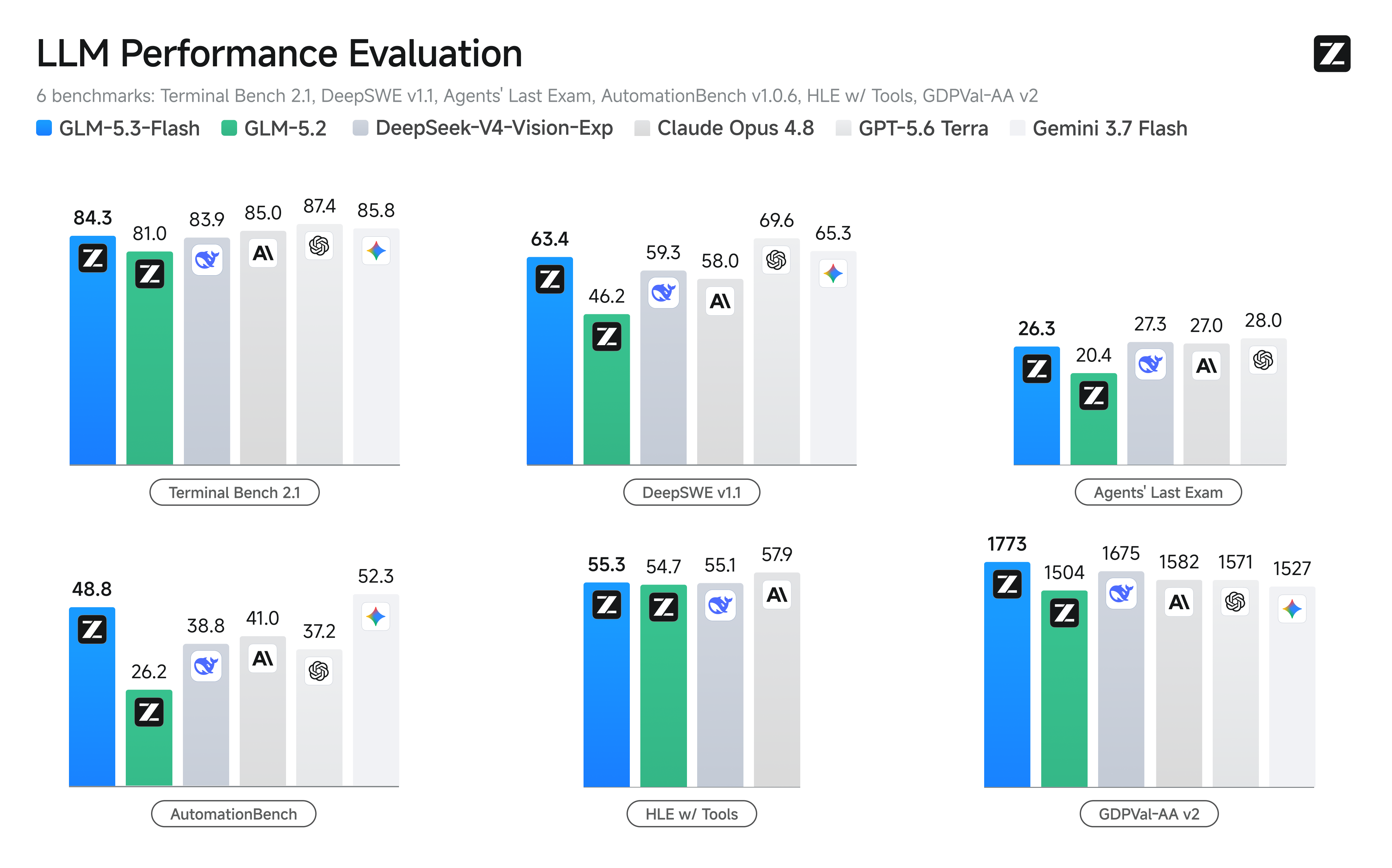
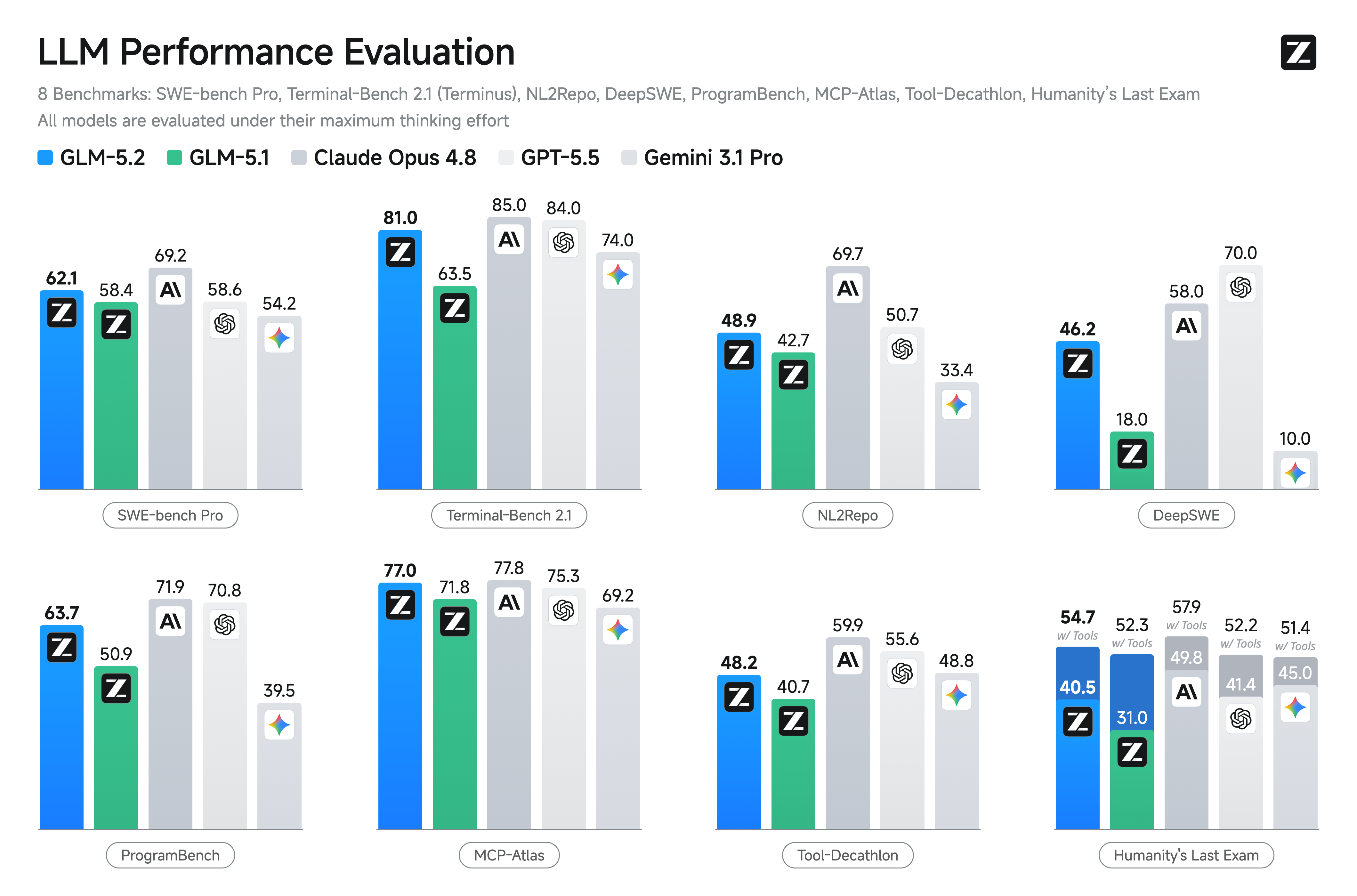
# GLM-5.2 👋 Join our WeChat or Discord community. 📖 Check out the GLM-5.2 blog and GLM-5 Technical report. 📍 Use GLM-5.2 API services on Z.ai API Platform. 🔜 Try GLM-5.2 here. [Paper] [GitHub] ## Introduction We're introducing GLM-5.2, our latest flagship model for long-horizon tasks. It marks a substantial leap in long-horizon task capability over its predecessor GLM-5.1 and, for the first time, delivers that capability on a **solid 1M-token context**. GLM-5.2's new capabilities include: - **Solid 1M Context:** A solid 1M-token context that stably sustains long-horizon work - **Advanced Coding with Flexible Effort**: Stronger coding capabilities with multiple thinking effort levels to balance performance and latency - **Improved Architecture**: We propose IndexShare, which reuses the same indexer across every four sparse attention layers, reducing per-token FLOPs by 2.9× at a 1M context length. We also improve GLM-5.2’s MTP layer for speculative decoding, increasing the acceptance length by up to 20% - **Pure Open**: An MIT open-source license — no regional limits, technical access without borders ## Benchmark ## Serve GLM-5.2 Locally ...

Repository: localaiLicense: mit

gemma-4-31b-scotoma-2-q4
Gemma 4 31B Scotoma 2 is a multimodal Gemma 4 31B instruction-tuned model from ReadyArt. It applies a bounded refusal edit and preference training intended to reduce repetitive prose patterns while retaining the base model's text and image capabilities. This entry uses the 18.7 GB Q4_K_M GGUF and the matching Q8_0 vision projector. License: Apache 2.0 | Base model: Google Gemma 4 31B IT

Repository: localaiLicense: apache-2.0

gemma-4-31b-scotoma-2-q8
Gemma 4 31B Scotoma 2 is a multimodal Gemma 4 31B instruction-tuned model from ReadyArt. It applies a bounded refusal edit and preference training intended to reduce repetitive prose patterns while retaining the base model's text and image capabilities. This higher-fidelity entry uses the 32.6 GB Q8_0 GGUF and the matching Q8_0 vision projector. License: Apache 2.0 | Base model: Google Gemma 4 31B IT

Repository: localaiLicense: apache-2.0

step-3.7-flash
**[ModelPage]**: https://static.stepfun.com/blog/step-3.7-flash/ ## 1. Introduction Step 3.7 Flash is a 198B-parameter sparse Mixture-of-Experts (MoE) vision-language model that combines a 196B-parameter language backbone with a 1.8B-parameter vision encoder for native image understanding. Engineered for high-frequency production workloads, it activates approximately 11B parameters per token and delivers a throughput of up to 400 tokens per second. Step 3.7 Flash supports a 256k context window and offers three selectable reasoning levels (low, medium, and high) so developers can easily balance speed, cost, and cognitive depth. We built Step 3.7 Flash for developers who need to scale agentic workflows that combine perception, search, and reasoning. It is designed to handle intensive tasks such as parsing massive financial reports in one pass, running multi-step search loops with cross-source verification, or operating concurrent coding agents in high-throughput pipelines. ## 2. Capabilities & Performance ### Multimodal Perception and Verification ...

Repository: localaiLicense: apache-2.0

privacy-filter-multilingual
A multilingual PII token-classification model: a fine-tune of openai/privacy-filter by OpenMed. It labels every token with a BIOES tag over 54 PII categories (217 classes) across 16 languages (ar, bn, de, en, es, fr, hi, it, ja, ko, nl, pt, te, tr, vi, zh), spanning identity, contact, address, financial, vehicle, digital, and crypto entities. In LocalAI this is a PII detector for the NER redactor tier: set known_usecases to [token_classify] (as below), and any model opts into redaction by listing this one under pii.detectors. The detection policy (which categories to mask vs block, and the score threshold) lives on this model's own pii_detection block - see the overrides below. It runs locally with no Python, served by the standalone privacy-filter backend's TokenClassify RPC (constrained BIOES Viterbi decode into UTF-8 byte-offset entity spans). Architecture: gpt-oss-style sparse MoE (8 layers, 128 experts top-4, ~50M active per token), bidirectional banded attention, o200k tokenizer; served via the openai-privacy-filter architecture. F16, ~2.7 GB.

Repository: localaiLicense: apache-2.0

privacy-filter-nemotron
A fine-grained English PII token-classification model: a fine-tune of openai/privacy-filter by OpenMed on NVIDIA's Nemotron-PII dataset. It labels every token with a BIOES tag over 55 PII categories (221 classes), trading the multilingual sibling's language breadth for category depth - identity, contact, address, dates, government IDs, financial, healthcare, enterprise, vehicle and digital entities (including api_key, ipv4/ipv6 and mac_address). For multilingual text prefer privacy-filter-multilingual instead. In LocalAI this is a PII detector for the NER redactor tier: set known_usecases to [token_classify] (as below), and any model opts into redaction by listing this one under pii.detectors. The detection policy (which categories to mask vs block, and the score threshold) lives on this model's own pii_detection block - see the overrides below. It runs locally with no Python, served by the standalone privacy-filter backend's TokenClassify RPC (constrained BIOES Viterbi decode into UTF-8 byte-offset entity spans). Architecture: gpt-oss-style sparse MoE (8 layers, d_model 640, 128 experts top-4, ~1.5B total / ~50M active per token), bidirectional banded attention, o200k tokenizer and a 221-way token-classification head; served via the openai-privacy-filter architecture. F16, ~2.8 GB. (A smaller Q8_0 quant exists on the GGUF repo for RAM-constrained use - validate it on your own data, since for PII a single dropped span is a leak.)

Repository: localaiLicense: apache-2.0

nemotron-3-nano-omni-30b-a3b-reasoning-apex
# Model Overview ### Description: NVIDIA Nemotron 3 Nano Omni is a multimodal large language model that unifies video, audio, image, and text understanding to support enterprise-grade Q&A, summarization, transcription, and document intelligence workflows. It extends the Nemotron Nano family with integrated video+speech comprehension, Graphical User Interface (GUI), Optical Character Recognition (OCR), and speech transcription capabilities, enabling end-to-end processing of rich enterprise content such as meeting recordings, M&E assets, training videos, and complex business documents. NVIDIA Nemotron 3 Nano Omni was developed by NVIDIA as part of the Nemotron model family. This model is available for commercial use. This model was improved using Qwen3-VL-30B-A3B-Instruct, Qwen3.5-122B-A10B, Qwen3.5-397B-A17B, Qwen2.5-VL-72B-Instruct, and gpt-oss-120b. For more information, please see the Training Dataset section below. ### License/Terms of Use Governing Terms: Use of this model is governed by the NVIDIA Open Model Agreement ### Deployment Geography: Global ...

Repository: localaiLicense: other

kimi-k2.6
🤗  huggingchat  |  📰  Tech Blog ## 1. Model Introduction Kimi K2.6 is an open-source, native multimodal agentic model that advances practical capabilities in long-horizon coding, coding-driven design, proactive autonomous execution, and swarm-based task orchestration. ### Key Features - **Long-Horizon Coding**: K2.6 achieves significant improvements on complex, end-to-end coding tasks, generalizing robustly across programming languages (Rust, Go, Python) and domains spanning front-end, DevOps, and performance optimization. - **Coding-Driven Design**: K2.6 is capable of transforming simple prompts and visual inputs into production-ready interfaces and lightweight full-stack workflows, generating structured layouts, interactive elements, and rich animations with deliberate aesthetic precision. - **Elevated Agent Swarm**: Scaling horizontally to 300 sub-agents executing 4,000 coordinated steps, K2.6 can dynamically decompose tasks into parallel, domain-specialized subtasks, delivering end-to-end outputs from documents to websites to spreadsheets in a single autonomous run. - **Proactive & Open Orchestration**: For autonomous tasks, K2.6 demonstra ...

Repository: localaiLicense: modified-mit

Page 1